Asscher Diamond Carat Size Chart: Approximate Millimeter Dimensions
Carat is weight; millimeters tell you how large the Asscher actually looks
Quick answer
There is no exact millimeter size for a given Asscher carat weight because depth, girdle and facet geometry vary. As a rough visual planning guide, a well-spread 1 ct Asscher often lands around the mid-5 mm range, while 2 ct stones often approach the upper-6 to low-7 mm range. Always use the actual grading-report measurements for purchase decisions.
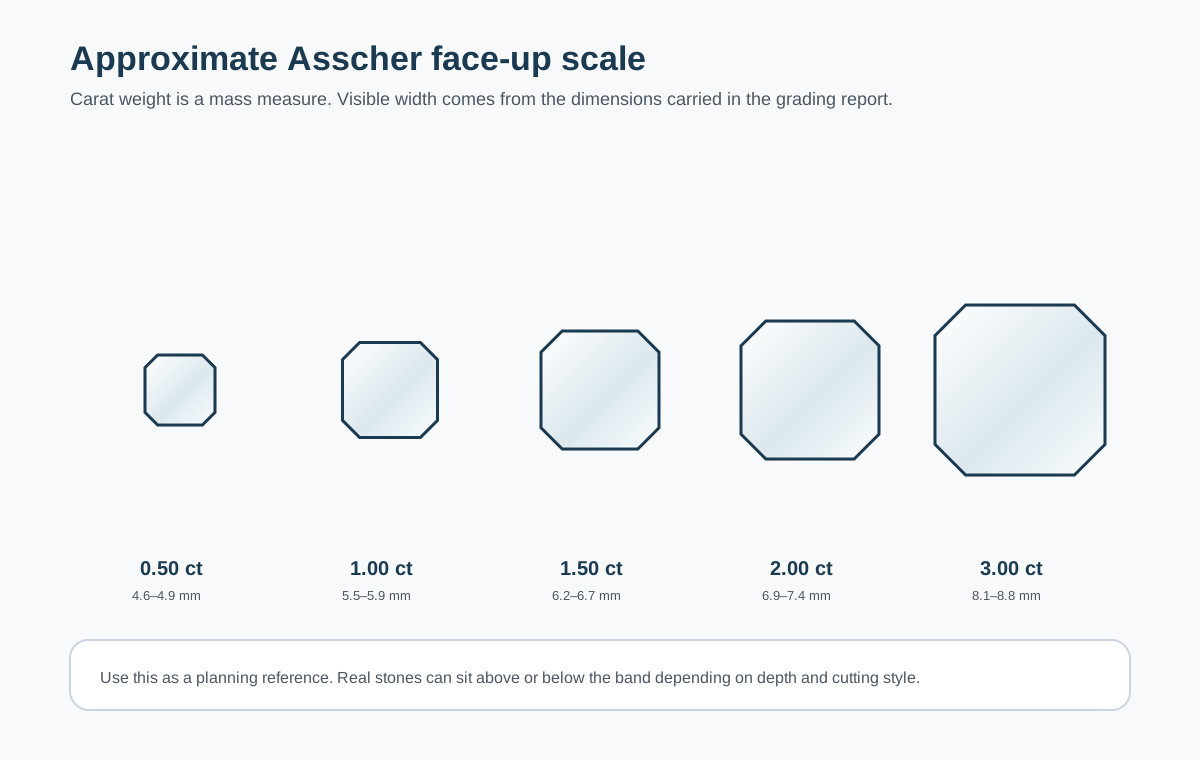
Relative face-up scale
~4.4 mm midpoint
~5.5 mm
~6.2 mm
~6.85 mm
Scaled from the site’s planning midpoints for relative comparison only. Real stones vary; use the grading report’s millimeter dimensions.
Key takeaways
- Carat measures weight, not visible diameter or width.
- Asschers tend to face up smaller than shallower shapes at the same carat because they carry more depth.
- Use a range rather than a single “exact” millimeter number.
- Compare length × width on the report before comparing price.
- Setting style can make the same stone look larger or smaller on the hand.
Approximate Asscher size chart
| Carat weight | Typical face-up width (approx.) | Planning note |
|---|---|---|
| 0.50 ct | about 4.2–4.6 mm | Compact center; halo can add presence. |
| 0.75 ct | about 4.8–5.2 mm | Noticeably larger outline without reaching 1 ct pricing. |
| 1.00 ct | about 5.3–5.7 mm | Classic benchmark; compare spread carefully. |
| 1.50 ct | about 6.0–6.4 mm | Strong presence; clarity/color become easier to inspect. |
| 2.00 ct | about 6.6–7.1 mm | Substantial center stone; setting proportions matter. |
| 3.00 ct | about 7.5–8.1 mm | Large face-up field makes pattern and clarity critical. |
These are editorial planning ranges, not laboratory standards. Individual diamonds can fall outside them.
Why two diamonds at the same carat can look different
Carat weight includes all of the diamond, including material below the girdle that you do not see face-up. A deeper stone can weigh more without showing a proportionally larger outline. Girdle thickness and corner geometry also change weight distribution.
What “good spread” means for an Asscher
Good spread means the diamond presents an efficient face-up size for its weight while preserving an attractive step pattern. Do not chase millimeters so aggressively that you accept a shallow, windowed stone. Size efficiency and optical quality have to coexist.
Think in square area, not round-diamond diameter
An Asscher covers the finger as a clipped square, so its visual footprint is different from a round. Width is the most useful quick comparison, but corner clipping and setting design influence how broad the center looks.
Settings can change perceived size
A thin solitaire band emphasizes the center outline. A halo increases visual footprint. Bezel settings create a bold frame but can make the metal part of the perceived shape. Side stones broaden the entire ring rather than the center diamond itself.
How to shop by visible size
- Choose a target width in millimeters.
- Search across a narrow carat band.
- Reject inefficiently deep stones only after checking pattern.
- Compare price per visible size, not just price per carat.
- Confirm the actual length × width on the grading report.
Visualize the size bands
Use the Asscher Size Visualizer to compare the site’s planning midpoint and millimeter range for common carat weights.
Compare Asscher inventory at our recommended partners (affiliate links).
Primary references & methodology
- GIA: How GIA Grades Diamonds — grading process, proportions, polish and symmetry.
- GIA: fancy-shape cut grading FAQ — explains that GIA does not currently assign an overall cut grade to fancy shapes.
- AsscherDiamond.com research methodology — how we distinguish laboratory facts, screening ranges and editorial observations.
Screening ranges on this page are editorial starting points, not an official overall Asscher cut grade. See the Research Center for methodology and source context. Research methodology →