1 Carat Asscher Diamond Guide: Size, Price, Quality & Buying Targets
The benchmark size where proportion efficiency can save real money
Quick answer
A well-spread 1 carat Asscher commonly measures roughly in the mid-5 mm range face-up, though actual dimensions vary. For balanced value, many buyers start around G–H color and VS2–VS1 clarity, then prioritize a strong step pattern and efficient spread.
Key takeaways
- Expect roughly mid-5 mm face-up width, not a fixed measurement.
- Compare 0.90–0.99 ct stones because visual difference can be small while pricing may differ.
- VS2 can offer value if the inclusion is well placed and eye-clean.
- G–H often balances color and budget.
- Do not buy a deep 1.00 ct stone that faces up like a much smaller alternative unless its beauty justifies it.
How big is a 1 carat Asscher?
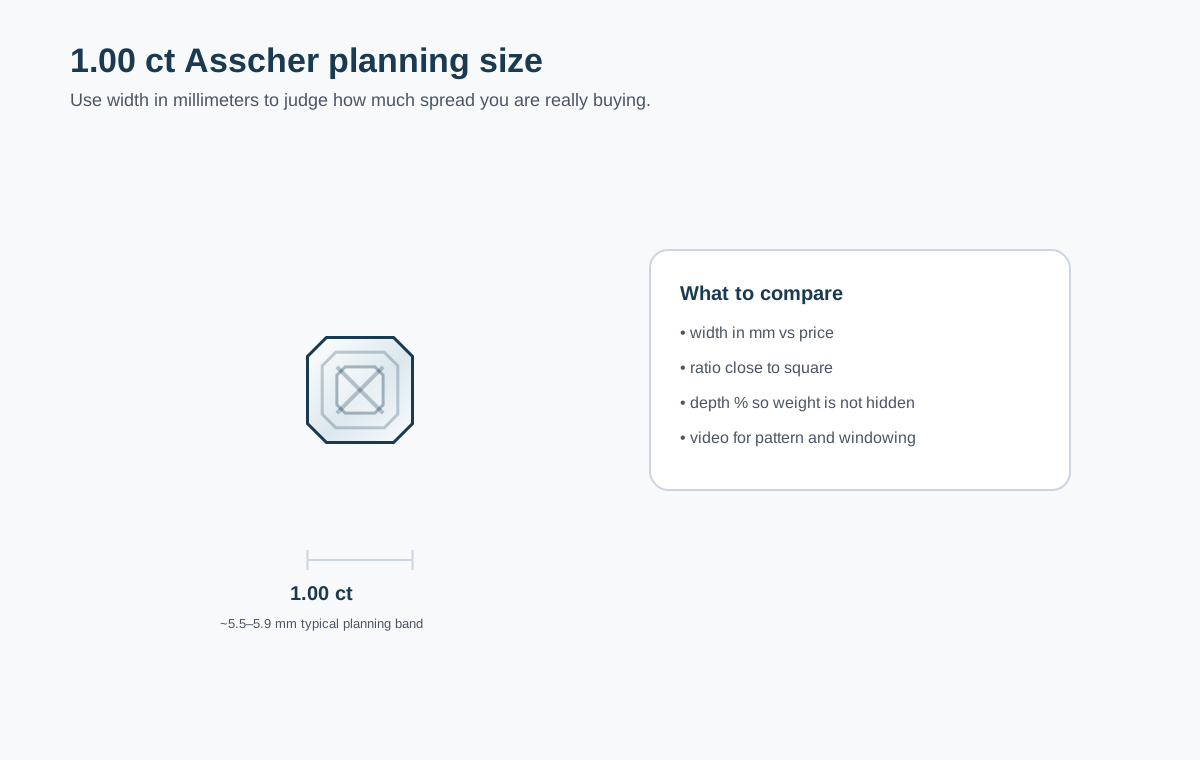
Many one-carat Asschers land around 5.3–5.7 mm in face-up width, but the actual report measurements matter more than the average. The clipped square outline tends to look compact and architectural rather than broad and sparkly.
Practical quality targets
For a balanced natural-diamond budget, G–H color and VS2–VS1 clarity are sensible starting points. Move higher only when you can see a benefit or value rarity. For lab-grown stones, higher color/clarity grades may cost less incrementally, but visual pattern remains the priority.
Watch for hidden weight
A one-carat label can psychologically anchor buyers, which makes inefficiently deep stones easy to overpay for. Compare millimeter width. A 0.95 ct stone with excellent spread and pattern may look just as large—or larger—than a deep 1.00 ct option.
Price strategy
Price changes sharply with origin, color, clarity, lab report and retailer. Use the Asscher price guide for current directional context, but compare like-for-like candidates rather than averages.
Why 0.90–0.99 ct deserves attention
Carat thresholds influence merchandising and buyer psychology. If a stone just under one carat has similar dimensions to a one-carat candidate, the visible difference may be small. This is one of the simplest ways to search for value without compromising cut quality.
Settings for a 1 carat Asscher
Solitaire settings keep the geometry clean. A halo can create a larger overall footprint. Bezel settings add a strong Art Deco frame and protect the clipped corners. Use a band width that does not visually overpower the center.
Compare Asscher inventory at our recommended partners (affiliate links).
Primary references & methodology
- GIA: How GIA Grades Diamonds — grading process, proportions, polish and symmetry.
- GIA: fancy-shape cut grading FAQ — explains that GIA does not currently assign an overall cut grade to fancy shapes.
- AsscherDiamond.com research methodology — how we distinguish laboratory facts, screening ranges and editorial observations.